
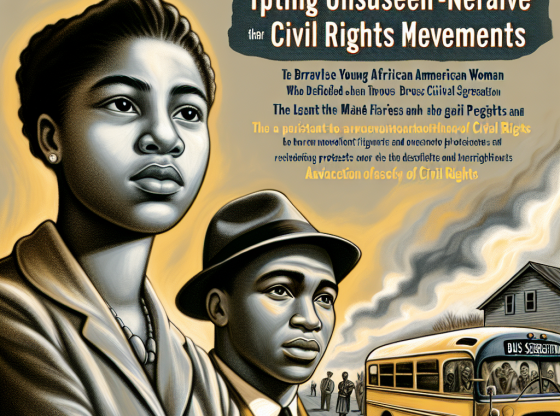
“Exploring the Hidden Desires of Civil Rights: The Untold Stories of Claudette Colvin and Bayard Rustin” delves into the often-overlooked narratives of two pivotal figures in the American civil rights movement. While icons like Martin Luther King Jr. and Rosa Parks are celebrated, Claudette Colvin and Bayard Rustin’s contributions reveal deeper complexities within the struggle for equality. Colvin, a courageous teenager who refused to give up her seat on a segregated bus months before Parks, exemplifies youthful defiance and resilience. Rustin, an openly gay man and key strategist behind the 1963 March on Washington, faced not only racial discrimination but also the challenges of being marginalized within his own movement. This exploration uncovers their hidden desires for justice, recognition, and authenticity, shedding light on how their stories enrich our understanding of civil rights history and highlight the intersectionality that continues to shape social movements today.
Claudette Colvin: The Unsung Hero of the Civil Rights Movement
In the tapestry of American history, certain threads shimmer more brightly than others, yet many remain hidden in the shadows. Among these lesser-known figures is Claudette Colvin, a young woman whose courageous act of defiance would echo through the corridors of civil rights activism. At just fifteen years old, on March 2, 1955, she refused to relinquish her seat on a segregated bus in Montgomery, Alabama, a bold move that came nine months before Rosa Parks’s more widely recognized protest. While Parks has rightfully been celebrated for her pivotal role, Colvin’s story deserves equal attention and reverence.
Colvin’s decision to stay seated was not merely a spontaneous act of rebellion; it stemmed from a deep-seated frustration with the systemic racism that plagued her daily life. As she sat there, she felt an overwhelming sense of injustice wash over her—a feeling that resonated deeply within her heart. In that moment, she became a vessel for the collective pain and anger of countless African Americans who had endured oppression for generations. However, unlike Parks, who was embraced by established civil rights organizations, Colvin faced a different reality. The world was not ready to acknowledge the bravery of a teenager, particularly one who did not fit the mold of the idealized civil rights activist.
As news of her arrest spread, Colvin encountered both support and skepticism. Many in her community were hesitant to rally behind her because she was young and unmarried, and they feared the repercussions of associating with someone so controversial. Yet, despite this isolation, Colvin remained steadfast in her conviction. She later became one of the plaintiffs in the landmark case Browder v. Gayle, which ultimately led to the Supreme Court ruling that segregation on public buses was unconstitutional. This victory marked a significant turning point in the struggle for civil rights, highlighting how even the quietest voices can create ripples of change.
The narrative surrounding Claudette Colvin is often overshadowed by the more polished tales of those like Rosa Parks or Martin Luther King Jr., but her contributions should be celebrated as part of the broader movement. Through her actions, she illuminated the complexities of race, gender, and youth in America during the civil rights era. Colvin’s experience underscores the notion that heroes come in many forms, and their stories are woven into the fabric of history, waiting to be told.
Moreover, Colvin’s journey reveals the romanticism inherent in the fight for justice—the passion, sacrifice, and unwavering belief in a better tomorrow. Her story inspires us to reflect on our own roles in advocating for equality and justice, urging us to recognize that every individual has the potential to spark profound change. In sharing her untold tale, we honor not only Claudette Colvin but also all those unsung heroes whose names may never grace the pages of textbooks yet whose spirits fuel the ongoing quest for civil rights.
Ultimately, by exploring the hidden desires and struggles of figures like Colvin, we deepen our understanding of the civil rights movement as a rich tapestry interwoven with diverse narratives. Each thread contributes to a larger picture—one that reminds us that true heroism often lies in the shadows, waiting patiently for its moment to shine. As we continue to seek justice and equity in our society today, let us carry forward the legacy of Claudette Colvin and ensure that her voice, along with many others, resonates loudly in our collective consciousness.
Bayard Rustin: The Overlooked Architect of Nonviolent Protest

In the tapestry of civil rights history, few figures shine as brightly yet remain as overlooked as Bayard Rustin. His life was a symphony of ideals, woven with threads of activism, intellect, and an unwavering commitment to nonviolent protest. Born in 1912 in West Chester, Pennsylvania, Rustin’s early experiences shaped him into a visionary who understood that true change requires both strategy and heart. As a young man, he was influenced by the teachings of Mahatma Gandhi and the principles of nonviolence, which became the cornerstone of his approach to social justice. This philosophical foundation would guide him through decades of tireless work, even as it often placed him in the shadows of more widely recognized leaders.
Rustin’s genius lay not only in his ability to articulate the need for equality but also in his extraordinary organizational skills. He was instrumental in planning some of the most significant events in the Civil Rights Movement, most notably the 1963 March on Washington. While Dr. Martin Luther King Jr. delivered his iconic “I Have a Dream” speech that day, it was Rustin who orchestrated the logistics behind this monumental gathering, ensuring that over 250,000 people could come together peacefully to advocate for justice. Yet, despite his pivotal role, Rustin remained largely unacknowledged, a testament to the complexities of race, sexuality, and politics during a time when being openly gay made one vulnerable to erasure from historical narratives.
Transitioning from the background to the forefront, Rustin faced numerous challenges; he navigated a world that often marginalized him for both his race and sexual orientation. However, rather than allowing these obstacles to deter him, they fueled his passion and determination. He believed deeply in the power of love and understanding as tools for social change, advocating for a movement that embraced diversity and inclusivity. In this way, Rustin’s vision transcended mere activism; it sought to create a society where every individual, regardless of their identity, could thrive.
As we delve deeper into Rustin’s legacy, we find stories of resilience and courage that resonate beyond his lifetime. He forged alliances across various movements, connecting labor rights with civil rights, thereby broadening the scope of activism to encompass economic justice as well. His commitment to nonviolence was not merely theoretical; it was a lived experience that challenged others to reconsider how they approached conflict and dissent. In a world rife with division, Rustin’s insistence on dialogue and peaceful resistance serves as a poignant reminder of the strength found in unity and compassion.
Ultimately, Bayard Rustin embodies the spirit of those who dare to dream of a better world while working tirelessly to make that dream a reality. His story invites us to reflect on the hidden dimensions of civil rights activism and encourages us to recognize the contributions of all individuals who have fought for freedom and equality. By honoring Rustin’s legacy, we not only acknowledge the sacrifices made by countless unsung heroes but also embrace the ongoing struggle for justice that continues to unfold today. Thus, as we explore the untold stories within our shared history, let us celebrate the profound impact of Bayard Rustin—a master architect whose vision for nonviolent protest remains ever relevant in our quest for a just society.
Intersectionality in Civil Rights: Colvin and Rustin’s Unique Perspectives
In the tapestry of civil rights history, threads of intersectionality weave a complex narrative that often remains obscured by the broader strokes of mainstream accounts. Among these intricate strands are the poignant stories of Claudette Colvin and Bayard Rustin, two figures whose unique perspectives illuminate the multifaceted nature of the struggle for equality. As we delve into their lives, we discover how their intersecting identities shaped not only their activism but also the very essence of the civil rights movement itself.
Claudette Colvin, an unyielding spirit at just fifteen years old, refused to give up her bus seat to a white woman in Montgomery, Alabama, nine months before Rosa Parks’ more widely recognized act of defiance. This courageous moment was not merely a singular event; it was a manifestation of Colvin’s deep understanding of her own identity as a Black girl navigating a world rife with racial injustice. Her experience underscored the complexities of being both young and Black in a society that sought to marginalize her existence. Yet, despite her bravery, Colvin’s story remained largely untold for decades, overshadowed by the narratives surrounding more prominent figures. It serves as a reminder that the fight for civil rights is not monolithic; rather, it is enriched by the diverse experiences of individuals who challenge societal norms in different ways.
Similarly, Bayard Rustin emerged from a distinct yet equally powerful vantage point. A gay man and a key strategist behind the 1963 March on Washington, Rustin faced the dual challenges of racism and homophobia within both the civil rights movement and society at large. His identity informed his approach to activism, as he adeptly navigated the intersections of race and sexuality, advocating for justice while grappling with the prejudices that sought to silence him. Rustin’s contributions were pivotal, yet they were often overlooked due to his sexual orientation. This neglect highlights the need to acknowledge all facets of one’s identity when discussing the legacy of civil rights leaders, illustrating how their struggles resonate beyond mere labels.
As we reflect on the narratives of Colvin and Rustin, it becomes evident that their stories are intertwined with themes of resilience and courage. Colvin’s youthful defiance and Rustin’s strategic brilliance reveal how individual experiences shape collective movements. They remind us that the fight for civil rights cannot be separated from the nuances of identity; each person’s journey contributes to a richer understanding of what it means to seek justice. Furthermore, their legacies beckon us to embrace a more inclusive approach to activism, one that recognizes the validity of diverse voices and experiences.
By exploring the hidden desires of these remarkable individuals, we gain insight into the profound impact of intersectionality within the civil rights movement. Their stories encourage us to look beyond surface-level achievements and engage with the deeper struggles that define the quest for equality. Ultimately, Claudette Colvin and Bayard Rustin stand as testaments to the power of embracing one’s full identity—an enduring lesson that continues to inspire new generations of activists striving for a more equitable world. In honoring their contributions, we not only celebrate their unique perspectives but also reaffirm our commitment to a civil rights narrative that encompasses all dimensions of human experience.
Legacy and Impact: How Colvin and Rustin Shaped Modern Activism
The legacies of Claudette Colvin and Bayard Rustin resonate deeply within the fabric of modern activism, illuminating paths forged by courage and conviction. While often overshadowed by more prominent figures in the civil rights movement, their stories reveal a profound impact that continues to inspire new generations of activists today. Colvin, with her audacious act of defiance at just fifteen years old, became a symbol of youthful determination. Her refusal to relinquish her bus seat in Montgomery, Alabama, echoed the sentiments of many who yearned for justice but lacked the platform to voice their grievances. This singular moment, though initially dismissed, laid crucial groundwork for the larger movement led by figures like Rosa Parks and Martin Luther King Jr. The bravery she exhibited not only challenged societal norms but also ignited conversations about race, youth engagement, and gender dynamics within activism.
On the other hand, Bayard Rustin’s contributions were equally transformative yet frequently relegated to the shadows of history. A master strategist and organizer, Rustin played a pivotal role in orchestrating the 1963 March on Washington, an event that crystallized the aspirations of millions seeking equality. His ability to unite diverse groups under a common cause showcased his deep understanding of coalition-building, a skill essential for effective activism. Despite facing discrimination due to his sexuality and being marginalized even within the civil rights community, Rustin remained steadfast in his commitment to nonviolence and social justice. His life exemplified the intersectionality of struggles; he understood that the fight for civil rights was inextricably linked to issues of labor, peace, and LGBTQ+ rights. Thus, Rustin’s legacy serves as a reminder that true progress is achieved when all voices are heard and valued.
As we reflect on the intertwined narratives of Colvin and Rustin, it becomes evident how their experiences shaped contemporary movements such as Black Lives Matter and LGBTQ+ advocacy. Today’s activists draw inspiration from Colvin’s early courage and Rustin’s strategic brilliance, recognizing that these qualities are vital in addressing ongoing injustices. The romantic notion of activism—of fighting for love, dignity, and respect—can be traced back to their unwavering dedication. Their lives encourage us to embrace vulnerability and strength simultaneously, reminding us that change often begins with individual acts of bravery.
Moreover, the lessons learned from their journeys emphasize the importance of acknowledging unsung heroes within any movement. By amplifying the stories of those like Colvin and Rustin, we enrich our understanding of history and cultivate a more inclusive narrative surrounding civil rights. Their influence extends beyond mere historical accounts; it compels us to engage actively in our communities, fostering dialogues that challenge systemic inequalities. In this way, their legacies continue to breathe life into modern activism, urging individuals to rise against oppression in all its forms.
Ultimately, exploring the hidden desires of civil rights through the lens of Claudette Colvin and Bayard Rustin reveals a tapestry woven with resilience and passion. Their untold stories urge us to look beyond the surface and recognize the complexity of the struggle for equality. As we navigate contemporary challenges, may we carry forward their spirit of boldness and solidarity, ensuring that the echoes of their sacrifices remain alive in our pursuit of justice.
Conclusion
The exploration of Claudette Colvin and Bayard Rustin reveals the often-overlooked narratives within the civil rights movement, highlighting their profound contributions and the complexities of their personal lives. Both figures challenge conventional representations of activism, showcasing that the fight for equality encompasses a range of experiences and identities. Their stories underscore the importance of recognizing diverse voices in history, as well as the intricate interplay between personal desires and collective struggles for justice. Ultimately, acknowledging these hidden desires enriches our understanding of the civil rights movement and inspires future generations to embrace inclusivity in social advocacy.